Workflow Tracker. Hundreds of event tasks, zero silently dropped.
- Status
- Live · the company’s working tool
- Client
- M4U Events (~30 staff)
- Stack
- Next.js · Prisma · Postgres · Slack API · QStash
- Scale
- 24 API routes · 14 data models · 126-test gate
- Year
- 2026
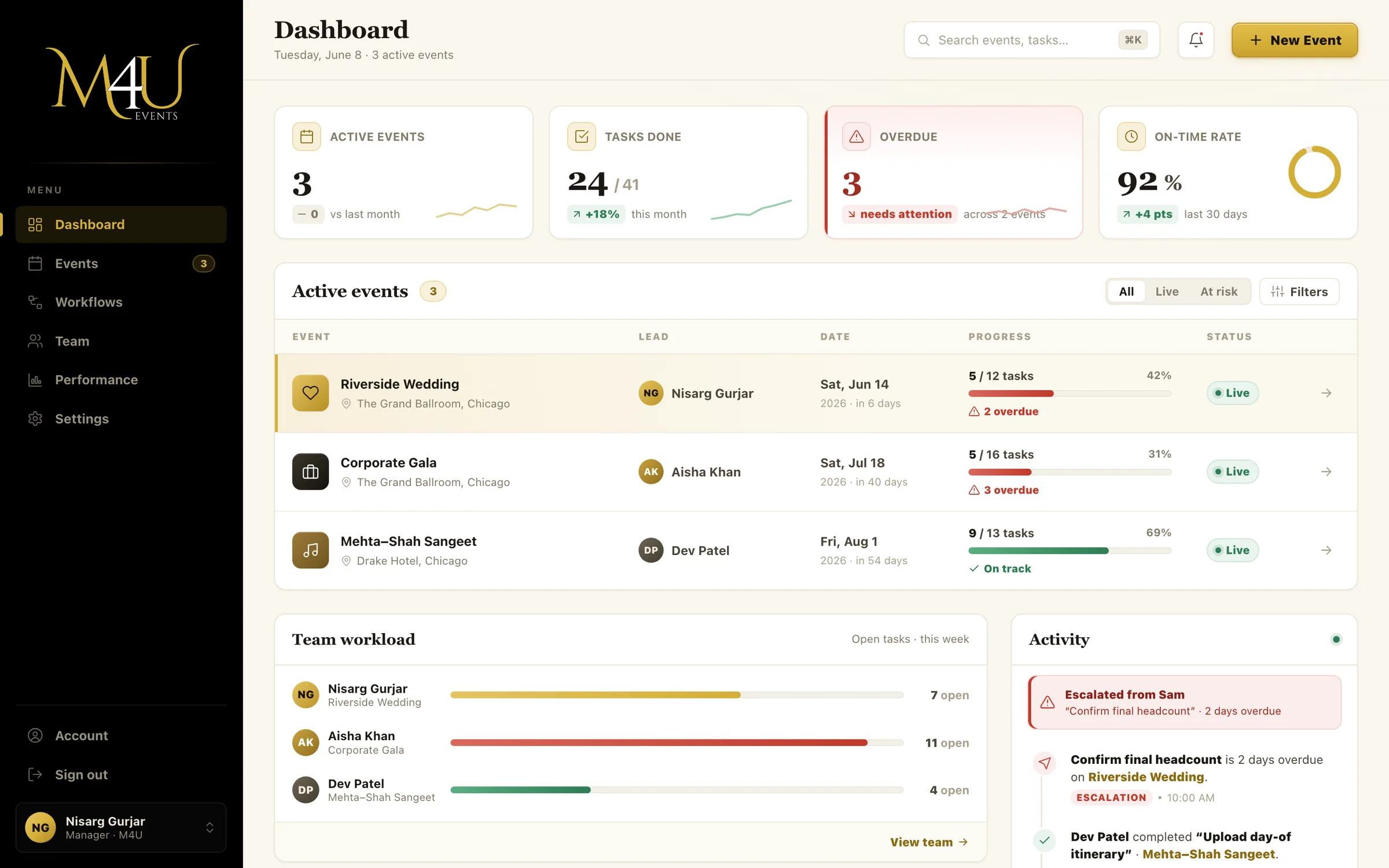
An events company runs on checklists: load-in, sound check, photo proof, teardown, all per event, per crew, every weekend. Spreadsheets and memory meant tasks slipped silently, and the founder chased people by text. The failure mode wasn’t missed work. It was missed work nobody noticed until the event.
- ◆A real workflow engine. Tasks with linear prerequisites and branching triggers: completing one task can spawn or unblock others, transactionally.
- ◆Photo verification. Some tasks require photo proof, converted server-side and stored in a private bucket.
- ◆A Slack bot that escalates. Overdue tasks DM the owner; keep ignoring them and the tone escalates, with per-rule throttles so nobody gets spammed.
- ◆Three-role access control. Admin / manager / staff scopes enforced on every route, with audit-logged edits.
- ◆Booking sync. Bookings flow in from the company’s booking platform, with a dry-run mode that reports what it would create before it touches anything.
- 1A booking arrives; its event gets a workflow from a template
- 2Tasks unlock as prerequisites complete; triggers spawn follow-ons
- 3Owners see their queue; some tasks demand photo proof
- 4An hourly cron sweeps for overdue work → Slack escalation
- 5A dead-man switch alerts if the sweep itself ever stops running
Concurrency and trust. Two people closing related tasks at once must not corrupt the chain, so status updates are TOCTOU-safe. The database enforces the precondition in the same statement that applies the change. Access control went through a real IDOR pass (can user A touch user B’s task by guessing an ID? Now provably no).
And because the escalation bot messages real staff, its inputs are sanitized against Slack-injection and its cron is watched by a dead-man switch: if the hourly sweep stops, the system tells on itself instead of failing silently.
- ✓126-test gate on the engine, scope policy, and sync paths.
- ✓Booking-sync dry run against live data: 89 fetched → 17 to create → 42 held for review → 0 errors.
- ✓Write-only audit trail on every edit.
Live as the company’s working tool at its own domain. The founder stopped being the escalation system, so the software nags and leadership doesn’t have to.
I reviewed the engine design change by change across 90 commits, each one gated on the test suite. Claude Code wrote the code. How I work →
Run an events business? I built Ajna for you.
AI automation for wedding & event vendors. Quotes in minutes instead of days, with a human always in the loop.